 ОРКСЭ
ОРКСЭ The Maasai tribe is one of the most iconic and well-known indigenous peoples of Africa. They are known for their distinctive culture, lifestyle, and traditions that have been preserved for generations. The Maasai people are predominantly pastoralists, relying on cattle herding for their livelihood. They are also known for their unique traditional clothing, colorful beadwork, and intricate hairstyles.
Когда вы впервые выходите из терминала прибытия в Танзании, вы можете увидеть местных парней и девушек, празднично одетых и радушно встречающих путешественников. Если вы посетите крупные танзанийские города, такие как Аруша, или пляжи Занзибара, вы можете увидеть людей, одетых в традиционную одежду – красно-синие клетчатые одеяния, обшитые бисером на руках и шее. Они рады позировать для вашей камеры, если вы можете предложить им небольшую чаевую. Относитесь к ним так же, как к Золушке в Дисней-парке – это всего лишь актеры и уличные артисты, зарабатывающие деньги, развлекая бездельных туристов. Среди них вы не найдете настоящего воина маасаи.
Местные сувенирные магазины и рынки продают разнообразные бусы, деревянные аксессуары и другие мелочи. Также для туриста не составит труда найти отличительные цветные шарфы и одеяла, известные как шука. Продавцы знают, что нравится иностранцам. Культура маасаи привлекает Восточную Африку, и, по крайней мере, в Танзании и Кении, атрибуты этого кочевого племени пользуются большим спросом среди туристов. Именно в удаленных внутренних землях Танзании и Кении обитают всемирно известные пришельцы из древнего африканского мира – маасаи.
Что мы знаем о маасаи?
Большинство документальных фильмов и развлекательных телепередач о Африке изображают маасаи как кочевых пастухов, обитающих в временных поселениях посреди африканской саванны. Они не примут городскую жизнь или современные технологии ни за что в мире. Мы видим этих племенных жителей Танзании в красных одеяниях, напоминающих древние римские тоги – единственная одежда, которую они принимают. Мы представляем их высокими и стройными, с длинными палками в руках, прыгающими в воздух без видимой причины – что это? Странная забава и игра, или существенная банальность?
Что из этого правда, а что выдумки бесчисленных режиссеров и путешественников-блоггеров? Разве эти рассказчики только гонятся за рейтингами и просмотрами на YouTube, всегда преувеличивая и разыгрывая?
Ну, мы можем поспорить, что современные маасаи придерживаются традиций племенных общин, живут за счет разведения скота, ничего не знают в письме и чтении, но хорошо владеют мечами, копьями и луками, разводят огонь трением и отвергают практически все удобства, которыми мы, современные люди, так балуемся в нашем мире XXI века.
Маасаи и несколько других племен, которые по-прежнему минимально подвержены удобствам сегодняшнего дня, являются живущими, но исчезающими возможностями соединения с нашим общим прошлым человечества.
Маасаи – коренные народы Танзании и Кении
The Maasai Tribes and Their Language
Типичная хижина Масаи
Типичная хижина Масаи строится как каркас из длинных костей, переплетенных с более тонкими гнущимися прутами. Хижины не имеют дверей – войти внутрь можно через открытый проход. Снаружи и внутри стены покрыты смесью навоза и влажной земли. Когда вода редка, что типично для тропического климата, используется коровья моча для увлажнения строительного материала. Крыша также смазывается и штукатурится той же негласной смесью и покрывается сухой травой.
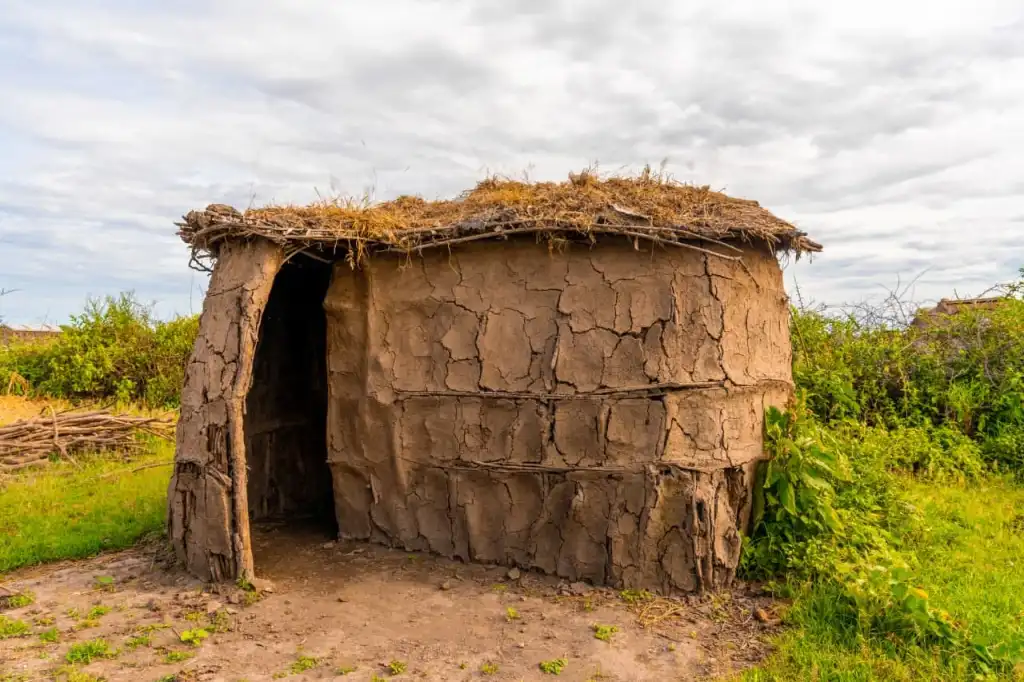
Эти хижины обеспечивают надежный укрытие от жары, дождя и ветра. Когда жарко, смесь навоза быстро высыхает и трескается. Когда это происходит, хижины проводят реновацию: стены и крыша дополнительно укрепляются дополнительными слоями навоза и земли. Это постоянный процесс, требующий ежедневного труда и чрезвычайно зависит от коров – как только они доставляют строительный материал, Масаи принимаются за работу, чтобы хорошее не пропало.
Крал – типичная деревня Масаи
Все хижины выстроены в круг, окружая загон для скота посередине. Коровы и козы приводят внутрь на ночь, чтобы защитить их от хищников. Типичный африканский колючий забор устанавливается вокруг поселения, состоящий из прочного забора из колючих ветвей акации высотой не менее полутора метров. Как правило, есть только один широкий проход для людей и скота в и из поселения. Такие поселения Масаи называются кралами или бомас.
Бомас типичны для всех восточноафриканских племен. Иногда внутри бомы устанавливается дополнительный круглый забор, а ночью между двумя заборами разводят костры. В отдаленных районах это распространенный способ защиты бомы от стай львов, сгущающихся и приходящих к домам людей. Были случаи, когда племенным семьям, число мелкого стада которых было разорено и уничтожено дикими хищниками. Это наиболее распространено в сезон пастбищ, когда саванна наполнена свежей травой.
Когда приходит время двигаться и переходить на новые пастбища, Масаи сбрасывают сухой навоз и землю с стен, разбирают каркасы из палок и переносят весь материал на новое место, где через несколько дней появляется новое поселение.
В прошлом для строительства бомы использовались животные шкуры для лучшей защиты от воздействия погоды – некоторые племена практикуют это и по сей день. Те, кто живет ближе к городским районам, открывают для себя роскошь современных строительных материалов, таких как шифер, оцинкованные листы, поликарбонат и железо. Сегодня, даже в отдаленной Африке, вы можете увидеть деревенские дома, построенные из материалов, широко используемых повсюду в мире, напоминающих дома ваших соседей.
Работа Масаи
Единственная и главная забота племени – скотоводство. Масаи разводят коров, коз и овец – не птицу. Земледелие считается недостойным родом занятий для гордых и свободных людей Масаи.
If you are a Maasai, cows are your true meaning of life. The larger your herd is, the higher social status you have. Your family’s and village’s welfare hinge on how many cows you have. Herding and guarding the cows is an adult man’s business. Boys learn this from early childhood. As early as 4 or 5 years old, boys are sent to herd goats solo, without any adults nearby. Older boys are trusted with larger cattle.
Milking is a woman’s task. Apart from that, Maasai women do all the housework: fetching water from springs, stocking up on firewood, tirelessly repairing dried-out huts’ walls and roof, taking care of children, and doing everything else required to sustain life in the village. Beadwork is also a woman’s job.
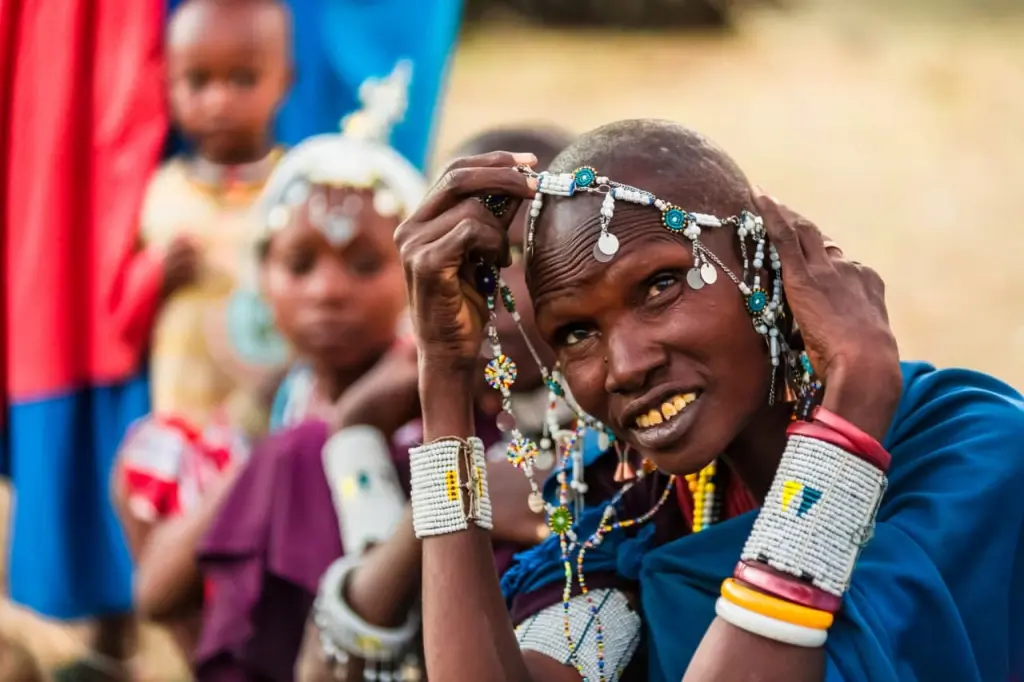
A Maasai woman wearing traditional beads
Maasai is a patriarchal society. Male elders control the strict observance of traditions in the village. One can become an Elder at quite a young age – even soon after turning 30-years-old, one can achieve a well-deserved “retirement.” As soon as the Morans become junior elders after undergoing a special rite, their duties are reduced to a minimum: tending their Elder’s image, appearance, and weapons, nominally guarding the village, holding councils, instructing women and teenagers on their chores, and counting cows coming back from pasture. If you are an Elder, you also have the right to go to town to relax and have fun in local bars. Encounters with civilization aren’t completely cut off, as you can see.
There is no data about the same “retirement” practices for women, though.
Tribal Life
Communal social system assumes that several families united by blood bonds reside together. Cattle and other property are in common use; each clan member is to respect the accepted rules and partake of common chores and benefits; the clan, in its turn, is liable for the actions of every member of the community.
All male members of the clan take turns bringing goats and cows into the plains to graze; they search for waterholes for the cattle and protect the herds from cattle raids and attacks of lions, leopards, and hyenas. Women do their chores jointly. They repair houses, milk the cattle in the evening, care for children, and fetch water and firewood together. In well-off villages, donkeys are used to transport loads. As of late, the most advanced Maasai obtain motorized vehicles, although these are still rare and non-typical.
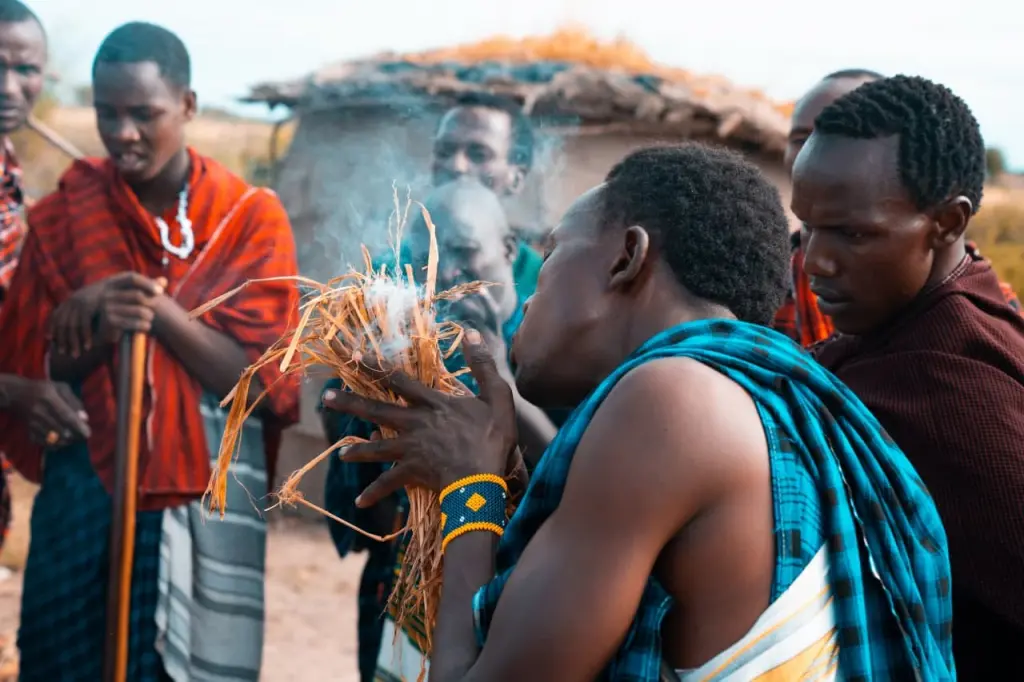
Maasai men kindling a fire
Young men stealing cattle from other clans are looked upon as something usual. An ancient belief has it that only the Maasai people were bestowed with goats and the cows, hence only they shall have the right for each and every head of cattle there is on Earth. All other crimes are punished by a fine, though. Thus, if an unruly young warrior attacks a member of another clan or, God forbid, a stranger from a wide civilized world, the whole village will be liable to pay the fine (in cows, of course). And squandering such a valuable belonging is an absolute no.
Bringing Up Young Maasai
The children start pasturing the small herds of goats once they have learned to walk unassisted. Each day they are sent further and further away from the village. The boys of three armed with a stockman’s twig are not a rare sight far outside the boma. If a predator appears, the boy shall call for the adults. By the age of 8 or 10, the young stockmen take large herds of sheep and goats away to graze for the whole day. These are the traditions of the cattle-herders by birth.
Girls, too, perform duties, helping their elders from an early age. The Maasai don’t have a habit of idleness, and a tender age is not an excuse. Judging by European standards, children are brought up harshly. For example, hitting a child for misbehavior is considered right and practical. The more pain you endure in childhood, the stronger warrior or hard worker a child can become when they grow up.
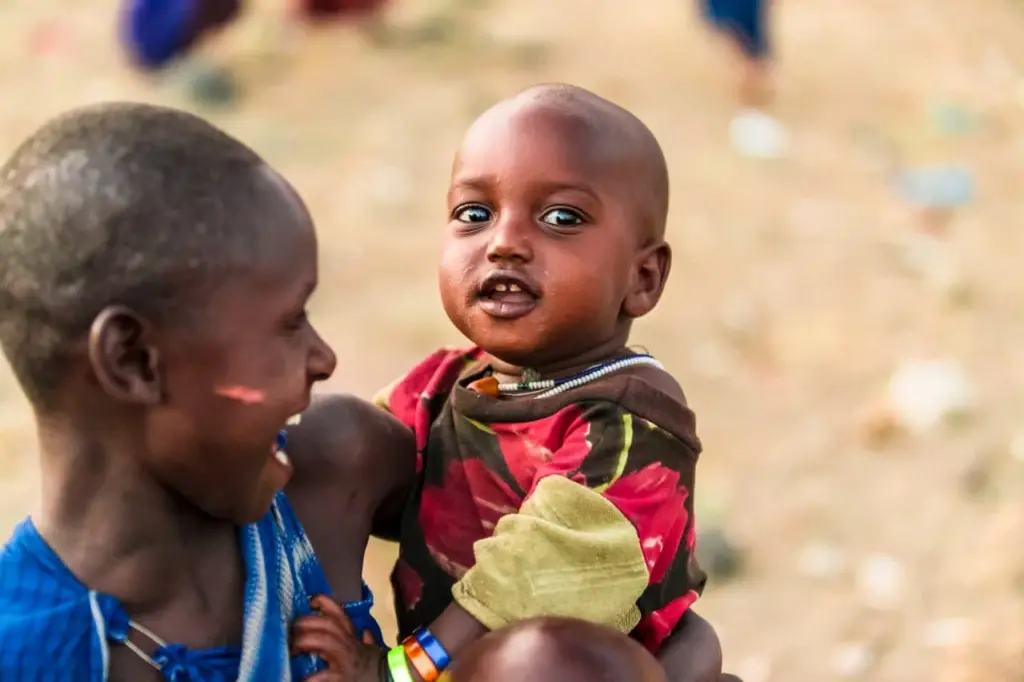
Young Maasai mother with a child
Coming of Age Rituals and painful Circumcision
All adolescents must at some point undergo the initiation ritual of becoming adults in order to prepare for marriage and childbearing. It is called emorata. Those who have not undergone initiation are despised in their native villages; they are not considered full members of the community and cannot marry or bear children. When they die, their bodies are not returned to the savannah but buried in the ground in disgrace.
At the age of about 12 or 14, the boys are circumcised. It is a painful and risky procedure, as it is performed without a single hint of hygiene and disinfection and, moreover, in plain sight of the other villagers. The boys are not allowed to scream or show they are in pain. A warrior should suffer the removal of his flesh with a knife in complete silence. The damaged organ would take several months to heal, and during all this time, it would cause discomfort and painful sensations. As a rule, though, the healing is successful.
The situation with female genital mutilation is significantly more difficult. At the same age as the boys, at 14, or sometimes even earlier, the girls’ heads and eyebrows are shaved clean. A woman from the tribe with enough experience then takes a dirty blade and cuts off a part of a young girl’s genitalia as the girl screams and thrusts in pain.
Let’s cut the details and only mention that every now and then, this severe procedure is carried out with excessive enthusiasm and the visible genitalia are as good as gone as a result. Potentially chronic inflammations, sepsis, painful urination and sexual intercourse last for a female’s lifetime, as well as the risk of infertility and stillbirth – these are, alas, the common consequences of female circumcision, or, medically speaking, of deliberate genital mutilation.
Awareness Programs
In Tanzania and Kenya, female genital mutilation is illegal. But who will force the self-righteous Maasai to obey the law of statesmen prying into their own business?! All the more reason for parents to think they are doing a good thing for their sons and daughters. An uncircumcised woman will not be taken as a wife, she will never be able to bear offspring, and she is deemed unclean.
So the women have to cut to the chase themselves. They are trying to teach sex education in schools, and the UN is actively educating Maasai women. Women from different villages, ready to discuss their national traditions, are brought together to lecture them about the basics of anatomy, medicine, and the principles of equal rights. Then these women have to retell it to their fellow tribesmen.
The process of raising awareness among the Maasai is progressing albeit slowly. Female circumcision is less frequent. And some observers note that in this nomadic tribe, information about HIV has been spreading wider in recent years. And this is of high relevance to the Maasai, who practice polygamy and sharing wives with all peers except close relatives.
The Maasai Hierarchy
After such painful rituals, the circumcised adolescents take some time to recover as their bodies recuperate. It takes six months or longer, with the young men being housed separately and exempted from work. They are now called morans and are considered young warriors.
The girls can soon be given in marriage. Their fathers are offered cows as a ransom by the grooms’ families. As a rule, young women are taken as wives by those who are older and already own their own herds. If a woman chosen becomes not the first wife, then her approval of the older wife is obligatory. The more cows a Maasai warrior owns, the more women he can afford. If the widespread norm is considered to be having up to three wives, the rich men may have as many as ten. In some cases, the number of wives could be as high as thirty.
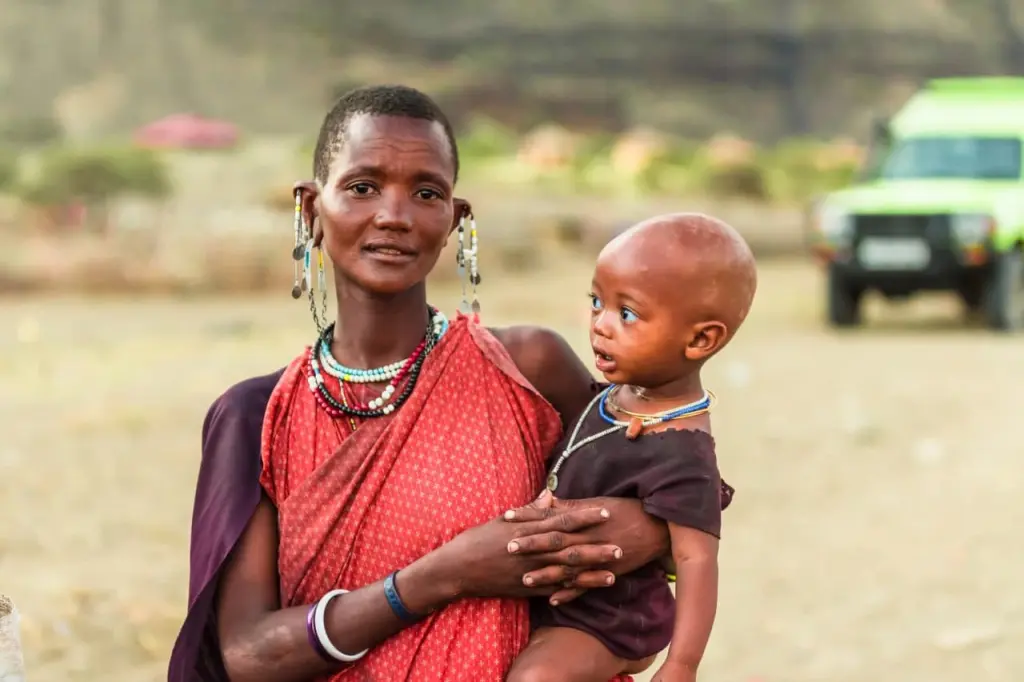
A Maasai woman with a child
In some clans, a woman may also have several husbands. In addition, Maasai sexual traditions allow men to offer their marital bed to peers of equal status. The wife must give her consent. But if a woman gives birth to a child from such a casual union, her husband is considered to be the father.
Moran warriors are obliged to herd cows for several years and, on an equal footing with the older members of the community, to provide for the village and guard it. During this period, the men grow their hair long, braid it and dye it with ochre. This is how they are most often seen in the famous photos while doing the jumping dance.
At the age of 30 or 35, the men go through another ritual that raises their status. Moran warriors now become junior elders; they have their hair shaved off and are exempted from compulsory labor. The men can then start their own households, get married, and leave the village to form a new settlement. More often, they stay in their home village and help the elders manage the household. This can mean absolute idleness, giving orders to the younger warriors and women.
When the village needs a new chief elder, he is chosen from among the younger elders. The eldest male of the clan strictly enforces customs, resolves disputes and conflicts, makes decisions about migration, and deals with other key matters in the community.
Traditions and Rituals of Maasai
In addition to initiation rites and major rituals that elevate the status of warriors, the Maasai tribes of Africa have other customs. One of the first that children encounter is the removal of their lower front teeth. This is considered a beautiful and natural decoration for little girls. Boys have a different trial waiting for them, the ceremony of fire marks. They must test their willpower by walking on their feet and hands over red-hot coals.
There is also a tradition of tattooing the children; during the ceremony, the children must endure pain. As the boys and girls reach the age of seven, they get their ears pierced. This procedure is very painful because it damages not only the soft tissue but also the cartilage. Then a hole is made in the lobe, which is gradually increased in size. This is achieved by inserting wooden and beaded ornaments and stretching the hole further and further.
There are also special festive ceremonies to commemorate the initiation into the ranks of warriors – a milk and a meat ceremony. But they are connected with the tradition for the moran warriors to live in separate camps, which is now becoming obsolete. For natural reasons, the custom of leaving for several years to live in separate camps has lost its relevance today and is not observed by all clans.
The most controversial tradition, the obligation to kill a lion to become a true moran, will be discussed below separately, as well as the rituals in which the Maasai drink the blood of their cows.
The Famous Jumping Dance
The best-known Maasai rite involves the young men jumping while performing a national dance. The dance is called the adumu. It is performed by the young warriors-to-be as they prepare to undergo the initiation rite.
They put on the garments not restricting their movements, stand up in a circle and jump the highest they can. Few can lift their feet so high from the ground. With that, Maasai land on tiptoe without touching the ground with their heels.
Alone and in twos, in rhythmic succession, tall young men clad in red blankets demonstrate their best skills. The best-trained warrior is the one who jumps higher than the others. This skill was probably crucial in times of rampant wilderness: there were few trees on the vast plains that one could climb, so jumping on the spot gave information about what was happening around, whether predators were approaching the herd, or whether warriors from hostile tribes were preparing an ambush.
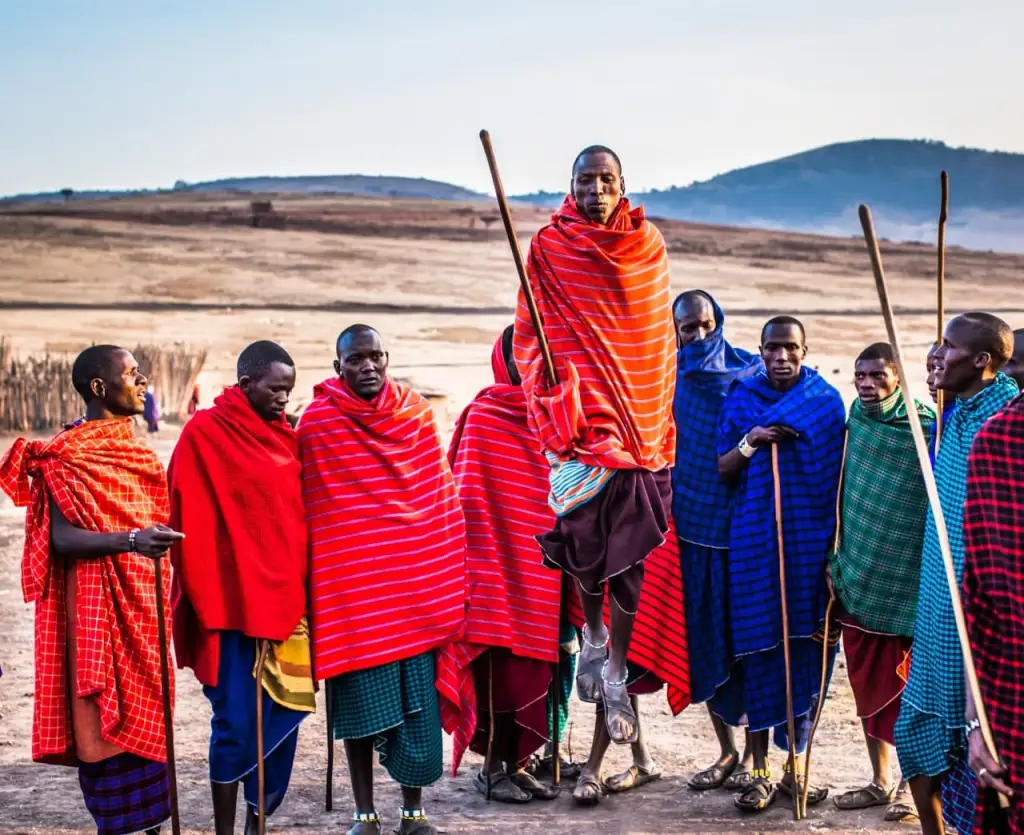
Maasai warriors performing the adumu dance
The ritual dance usually goes on the whole day long. Today, it has become a hallmark of not only the Maasai tribe but of the entire Africa. No wonder the jumping dance is an obligatory performance before the tourists, especially when the cameras turn on. Everybody benefits from the popularity of the dance, and thus the adumu can often be seen performed by other African peoples.
Maasai Garments — Colorful Shuka Capes
Almost every photo shows the Maasai men and women wearing bright red, or sometimes blue or lilac capes. Alongside the jumping dance, the clothes have become a distinctive feature of these nomads. This has yet not always been so.
Traditionally, Maasai wore animal hides for capes. At that, it was customary for the men to use calf hides, and the sheepskins for the women. The second half of the XXth century, the time of the establishment of the United Republic of Tanzania, brought along a completely unexpected fashion for these single-colored and checked cotton capes. These are called shuka and are worn in the same manner as the ancient Roman toga.
Nowadays, it is impossible to imagine the Maasai not wearing their colorful wraps. One can put on up to three shukas at a time. The first two layers are usually wrapped around the body, and the third is flung on the shoulders and serves as a cloak of sorts. Near the Tanzanian coast, kikoi kerchiefs are added to the garment; these are less bright and usually have a checkerboard pattern. It is a traditional Tanzaninan fisherman attire that the local Maasai found to their liking.
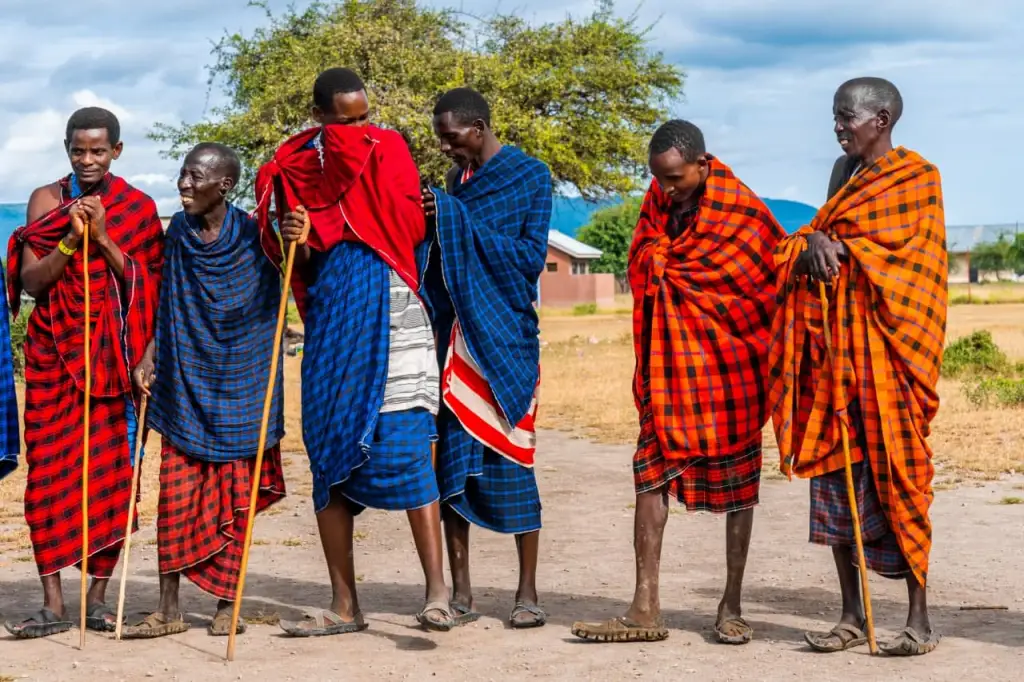
Maasai warriors wearing traditional shukas
Naturally, the dwellers of remote poor villages can not afford attractive shukas, so the local sharp dressers still have to make the animal hides do.
Another noteworthy feature of the Maasai clothing is the footwear. Paying closer attention to the photographs one can find out that nowadays quite a lot of the tribesmen wear sandals self-made from the old automobile tires. A practical and comfortable solution, you bet!
Beaded Ornaments
Bracelets, necklaces, and ornaments for head and ears made of multicolored beads are obligatory attributes of any self-respecting Maasai. Experienced travelers note that the Maasai are always neat and well-groomed. You will never come upon them with their hair disheveled, faces dirty, or not wearing any ornaments. Both women and men always try to look neat and bright.
Both men and women often decorate their ears and heads. They wear bracelets on their wrists and shins. On the necks of women, beaded discs are strung; often, these are so layered the body beneath them can’t be seen. These discs can lie softly like bibs or remain firmly shaped, surrounding a woman’s head from below.
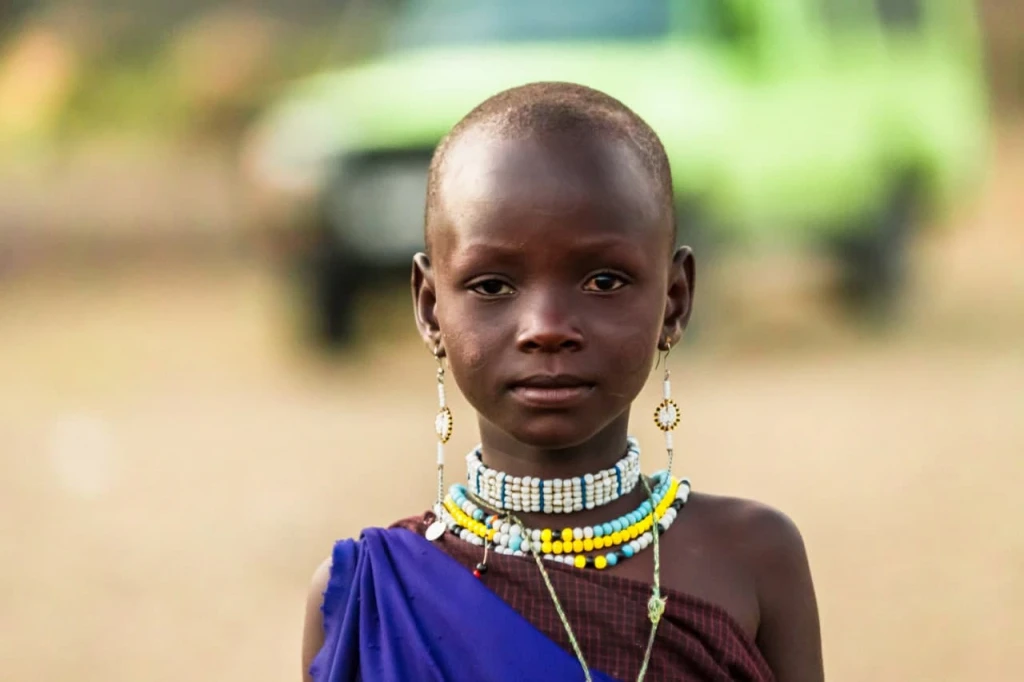
A Maasai girl wearing her beadwork
Beadwork is favorite among many peoples of Africa, but the skilled Maasai artisans seem to have outdone everyone in their desire to stand out and become the most visible on the continent. In their spare time, Masai women make beaded ornaments and souvenirs for sale. They often sell those right from the ground by the roads near the villages.
Maasai Weapons
The permanent attributes of the warriors of the tribe are a long pole, a short sword in a scabbard and a club with a thickening on one end which can be a melee weapon or a missile.
The pole is used as a staff to lean on during walking and performing the herding duties. The Maasai are capable of walking great distances. For example, many of them often walk from their settlement to town along the road, as they have no possibility to travel by vehicles. They also often stand for long periods in the middle of the savanna while their cows graze around them. The staff they lean on helps them stand straight. With due attention, one can see that the Maasai boast perfect posture. They never slouch or lie on the ground. The warriors’ natural pride does not allow it.
The pole replaces the spear for warriors today though the spears are not uncommon among modern Maasai as well. They make it easier to move across the plain because a warthog, a hyena, or a larger predator can appear in the grass at any moment. Spears are made thin and flexible, with iron heads of various shapes. The Maasai constantly practice throwing their spears. The best throwers are able to send a spear flying at a distance of up to 100 meters.
The club is made of wood and is shaped like a femur (a thighbone). It can be used in close-quarter combat. Otherwise, it is a status symbol. It’s carried by men under the arm.
A short sword always hangs in a sheath on the hip. This attribute is a must for the Maasai and is always carried by them. In Tanzania, it is even allowed by airline regulations to carry the sword onboard on domestic flights to the islands of Zanzibar. The sword (or a long knife) may have no thickened handle, but the Masai are deft with it. Surprisingly, even during fast running and other activities, it remains at the hip and never hinders the warrior.
Wooden bows with arrows are not so rare. In most cases, there is no need to use them, but in remote settlements, they are still of practical use. Arrows can drive away small predators. You can use them for hunting birds or antelope. Despite the strict prohibitions on hunting in Tanzania, members of the Maasai tribe are allowed to hunt some species of cloven-hoofed animals.
Possession and carrying of firearms are strictly prohibited. It is another restriction of the official laws imposed on the Maasai, which, however, contributes to preserving the traditions in possession of edged weapons characteristic of tribal society.
The Maasai being natural-born warriors is not merely a historical reference but a skill that finds application in practice. Maasai men who leave their villages and accept wage labor are often hired as guards, for example in national parks, in remote hotels and other tourist areas, or even as private bodyguards. The image of trained Maasai warriors pays off in full.
The Maasai Food
Milk and meat are the core of the Maasai diet. Goat and beef are the first choices for meat because it is almost a crime to slaughter cows for food.
You have probably heard that the Maasai are not squeamish about the blood of cows and bulls. We will tell you below whether it’s really true.
Fruits and vegetables are almost never on the regular menu of nomadic warriors. The exceptions are women and children, as well as young men during those periods when they have to live and eat outside the village.
Recently, the proud Africans have also tasted foods that are not typical of their traditions. First of all, cornmeal, which they buy and add into milk to make porridges. Rice, potatoes, cabbage, and other agricultural products also make their way into the Maasai diet. This leads some clans to begin cultivating small vegetable gardens. In general, Maasai tribe culture condemns farming, which is considered a crime against nature.
The more familiar foods that supplement the meager and unpalatable menu are honey, sheep fat, and various tree bark and roots that can be chewed for a long time. Honey is used to make mead.
Here is another one of the seemingly strange Maasai traditions: women are not allowed to cook food for men, are not allowed to be present when it is cooked, and are not even allowed to look at it. If this happens, the defiled food will be thrown away. But this approach does not seem to apply to the whole tribe or to everyday life. Most likely, the custom is relevant only for periods when the moran warriors depart from the village to live separately, and they go to special places under the tree branches to cook meat there, and women are strictly forbidden to enter such places.
The Rigor of the Maasai Traditions
It is the faithfulness to the ancestors’ precepts and steadfast adherence to tribal laws that has ensured the vitality of Maasai culture as we know it. If you ask the members of nomadic clans why they continue to live as they do and give up more convenient technologies and practices, they will stubbornly repeat that this is how it’s done, that they have to do it. The Maasai say that if they abandon their way of life to create some new one, it will take thousands of years.
Out of this proud stubbornness is born the sense of self-worth that makes the Maasai resist the imposition of alien traditions and laws. They reject the attempts of Tanzanian authorities to teach them to write, to give everyone an ID card, to subjugate them to their beliefs. The Maasai pay little attention to appeals to stop wandering and switch to a settled way of life, and are always ready to pack and go in search of new pastures for the animals entrusted to them by the ancient god.
Despite all the savagery of manners and the cruelty of some customs, you begin to involuntarily respect the desire of these proud people to live by the precepts of their ancestors. After all, absolutely all peoples on earth have passed through this stage. It is impossible to condemn those who by some miracle stayed on this path. It seems more right to simply observe the living past unfolding incomprehensibly here and now, right before our eyes.
Further Reading and Watching on Maasai
There is a stunningly beautiful feature film called Maasai, The Rain Warriors. It was filmed in Africa, in the native territories of the tribe. All the roles were played by nonprofessional actors, young Maasai fellows. The director is Pascal Plisson, a French documentary filmmaker who has lived for several years in Tanzania and Kenya and has made many films about the nature and animals of Africa for television.
Having met and befriended many of the people of the Maasai tribe, Pascal realized at some point that he adored these people. He wrote an original script and persuaded professionals from Paris to come and film the Maasai as themselves. None of the novice actors could read, so they memorized the text by hearing. This was the world’s first feature film made in the Maa language.
Only a documentary filmmaker could capture the beauty of nature and the beauty of the local people hidden in the details so skillfully. If you want to observe in detail the real outfits, ornaments, hairstyles and lively natural facial expressions of the Maasai, be sure to watch this film.
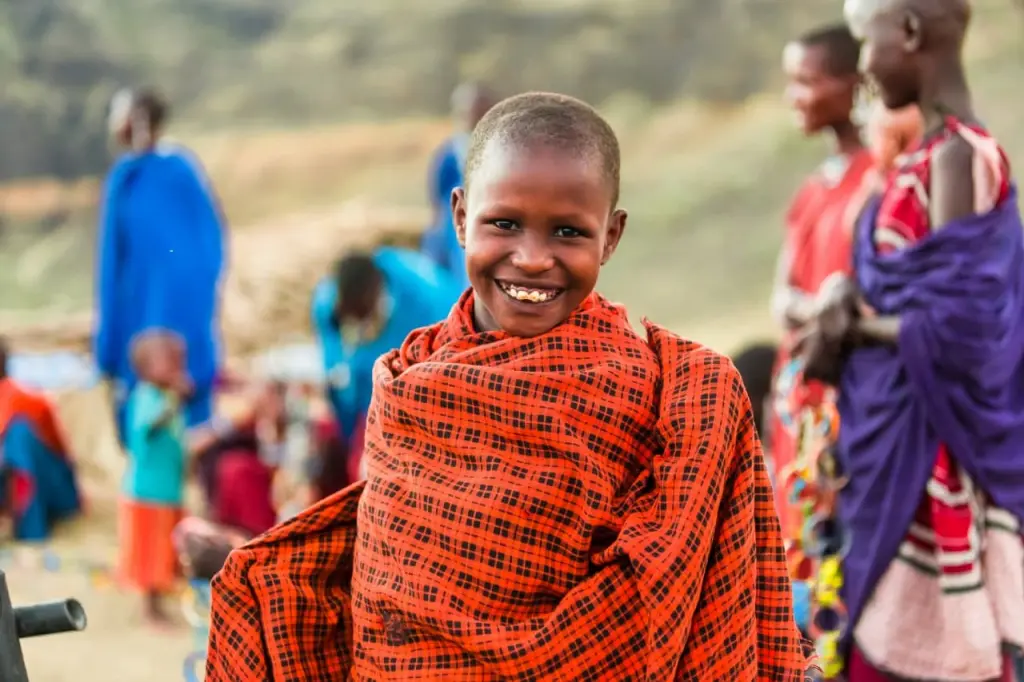
A soon-to-be Maasai warrior
The plot tells a fictional tribal legend in which young warriors must go on a quest to find and kill a ferocious lion, thus placating the Red God and returning long-awaited rain to the Maasai lands after a prolonged drought. The ethnic-style soundtrack was composed by the famous French film composer Ivan Cassar.
Another example, The White Maasai, is the autobiography of Corinne Hofmann, a Swiss woman who went on a trip to Africa with her fiancé in 1986 but never returned. There she met a Maasai warrior whom she fell in love with and decided to stay to marry him, live in a Maasai village, and eventually have a child there.
The story is more likely to appeal to fans (for that matter, the female fans) of psychological literature about relationships. The autobiography became a bestseller, which made the author want to continue writing a memoir about her uneasy relationship with Africa and Maasai culture. By the way, the book was later used as a basis for a same-name movie.
Frequently Asked Questions about Maasai
The Internet is full of unsubstantiated information about Maasai and some of their customs that never fail to arouse strong interest. We have undertaken to give an explanation on the most frequent questions. So, what’s a misapprehension, and what is God’s truth?
Is it true that Maasai hunt lions?
It is widely believed that the Maasai have a custom of killing lions to prove their strength and become true warriors.
The Maasai are fearless warriors, and in the past, there were indeed two types of lion hunting: personal and group hunts. In the first case, the hunt was often forced when the lion appeared while livestock was grazing. Group lion hunting was part of a competitive rite of initiation into the ranks of warriors.
The Maasai always behaved honestly toward the animals. They only fought a lion on the open plain to be on an equal footing with it. Speaking of weapons, the warrior used only a spear and sometimes took a shield with them. Maasai law forbade the pursuit of a drought-ridden lion or one that had been poisoned or caught in a net.
Once the lion population began to decline, the Maasai stopped the practice of hunting lions, turning from hunters into defenders. Now, in addition to the laws of honor, lion hunting is also forbidden by Tanzanian law.
The only exception may be the killing of a lion in a course of defense when the predator attacks grazing cattle or a Maasai village.
Do lions attack people?
It is very rare for lions to attack Maasai herds; this can cause damage to the nearby people especially if there is a small child around. Every incident of this kind is made public, becoming a feature in the newsreel of the local mass media. It is right to take this news in the same way that we take the rare shocking messages about stray dogs attacking children in remote and sparsely populated areas of Russia.
Do the Maasai actually drink animal blood?
Cow’s blood was traditionally a common diet item for the Maasai along with raw milk and meat. It was a natural source of nutritious proteins and salt for people who lived in the harsh conditions of limited food consumption.
Today, the Maasai drink cattle blood during rituals on special occasions. The blood of an ox or cow, or blood mixed with milk, is given to a sick person, a woman who has given birth, or a teenager who has just been circumcised. The blood also helps older men overcome the effects of intoxication after drinking alcohol.
The blood is mixed with milk to make it more nutritious. Such a drink is consumed both fresh and fermented. Cornmeal may also be added to it.
Are the Maasai the tallest people on the planet?
The average height of a Maasai is believed to be 190.5 cm / 6.25 feet, which makes the Maasai ethnic group one of the tallest, together with the Tutsi people.
Is taking photos always for money?
It is a common opinion that Maasai do not allow to take photos of themselves. At least not for free. Allegedly, they used to believe that taking pictures would take away a part of their souls, and then they got hooked on such an easy way to get money from tourists.
Actually, it all depends on the circumstances, the guests’ ability to negotiate and respect the locals and their customs. It quite often happens that Maasai are glad to meet a friendly traveler and are happy to do something nice for him or her, just to have a chat, and to pose for a spectacular photo.
Are the Maasai becoming extinct?
The estimated number of Maasai people is nowadays about 2,000,000. This exceeds the figures for the previous years when the census was held (at least according to the Kenyan authorities). So the total number of Maasai is increasing. When they talk about the extinction of the Maasai, they mean the extinction of the unique culture of this people under the onslaught of civilizational change.
Endangered Maasai Culture
Some of the Maasai traditions are now a matter of the past. For example, as the need to fight with neighboring tribes is no longer crucial, the period of service of the tribe’s men as warriors has been reduced. There are almost no camp settlements for the morans, and there are no competitions between them. There is a ban on stealing livestock and hunting lions and other predators whose populations have declined.
As the area of the pastures approved by the government has been reduced, and the consequent reduction in livestock numbers has been introduced, some clans were forced to gradually shift to a more resident way of life, to take up growing of agricultural crops, and to seek employment in towns and cities.
Speaking of the positive changes, female circumcision is becoming increasingly rare, and Maasai women are being educated and with it the opportunity to have much more influence over their living conditions arrives.
Civilization is penetrating deeper and deeper into Maasailand, bringing about significant changes in economic patterns, everyday life, traditions, and even in the diet of the Maasai. Those who are well acquainted with the culture of the people and the rapid processes taking place suggest that the Maasai community can exist in the current or a similar form for maybe a couple of generations more, after which the foundations of the customary ways will undergo significant erosion. More customs will become a matter of the past.
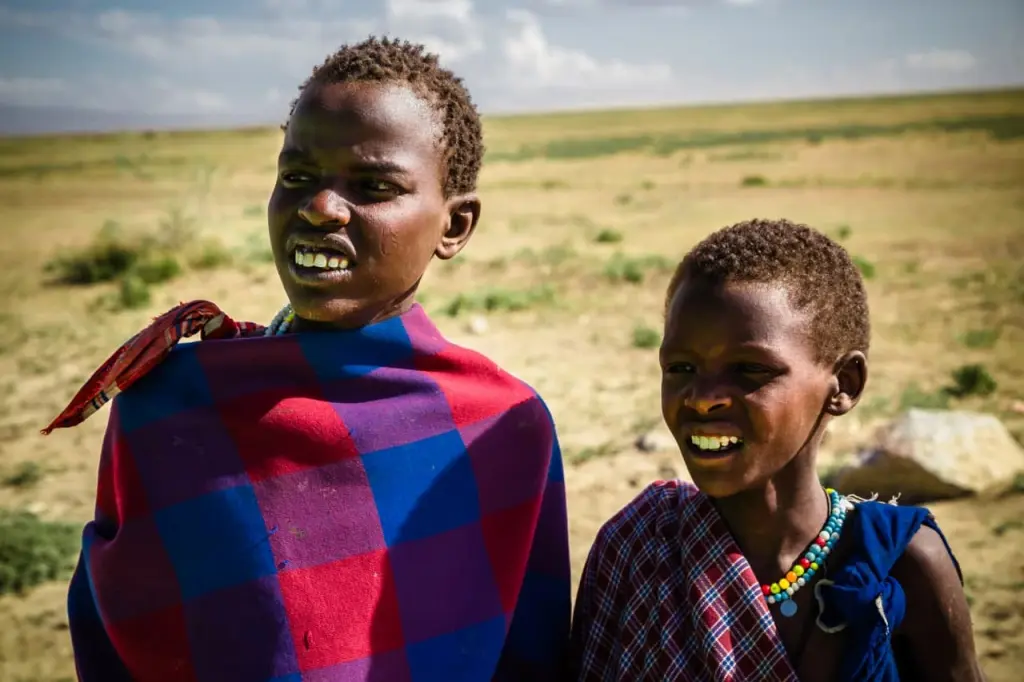
Young Maasai warriors in savannah
Today we have an opportunity to observe the life of tribal society in its natural manifestation. No texts, photographs, or video footage can replace a live communication with the people who bear the traditions that were once the norms for many peoples on the planet. It is all the more surprising that today’s tribes inhabit the same places from which the history of modern humanity began hundreds of thousands of years ago.
If you want to see the colorful Maasai with your own eyes and get in touch with their unique culture, write to us. Altezza Travel will be happy to arrange your trip to an authentic Maasai village in Tanzania.

LOCATED IN TANZANIA
Want to plan a memorable Tanzanian adventure?
Советский образ жизни
Текущая версия страницы пока не проверялась опытными участниками и может значительно отличаться от версии, проверенной 6 декабря 2022 года; проверки требуют 152 правки.
Другой главный итог пройденного пути — наш советский образ жизни. Атмосфера подлинного коллективизма и товарищества, сплочённость, дружба всех наций и народов страны, которые крепнут день ото дня, нравственное здоровье, которое делает нас сильными, стойкими, — таковы яркие грани нашего образа жизни, таковы великие завоевания социализма, вошедшие в плоть и кровь нашей действительности.
Неотъемлемой частью образа жизни советского народа стали советские праздники: Новый год, 8 марта, Первомай, День Победы, День Великой Октябрьской социалистической революции, День Конституции.
Потребление в СССР
Приоритет приобретения Рабочие более низкой обеспеченности (менее 75 руб. на человека в месяц) Рабочие более высокой обеспеченности (более 75 руб. на человека в месяц) Инженеры более низкой группы обеспеченности Инженеры более высокой группы обеспеченности Учителя
8 Стиральная машина Книги Стиральная машина Новый автомобиль Стиральная машина
9 Книги Новый автомобиль Мотоцикл Стиральная машина Спортинвентарь
«Когда речь идёт об уровне жизни, американцы называют одни показатели, а советские авторы — другие. Как их сопоставить?»
Интерьер комнаты 1950-х годов в Мурманском региональном музее
В советские времена личный автомобиль в буквальном смысле был роскошью, более доступным и распространённым средством передвижения были мотоциклы: Урал, Иж, Ява, CZ (Чезет). Особой популярностью мотоциклы пользовались у жителей сельской местности.
Общественные такси в Советском Союзе повсеместно были оборудованы счётчиками. При этом таксисты очень часто соглашались везти пассажира по тому или иному маршруту только заранее оговорив определенную сумму «сверх счётчика». На железнодорожных вокзалах или в аэропортах взять такси зачастую было непросто — надо было отстоять очередь, которая могла достигать нескольких десятков человек.
Бытовая аудио и видеотехника
Мужчины пьют возле магазина. Невский проспект, Ленинград, 1931 год
Мода и стиль советского человека
Возможно, этот раздел содержит оригинальное исследование.
Проверьте соответствие информации приведённым источникам и удалите или исправьте информацию, являющуюся оригинальным исследованием. В случае необходимости подтвердите информацию авторитетными источниками. В противном случае этот раздел может быть удалён. (4 ноября 2023)
Фотография, сделанная в Москве в 1964 году Томасом Тейлором Хаммондом
Мужская одежда осталась практически неизменной: английский костюм и галстук. Единственным изменением было то, что «буржуазный» котелок был вытеснен «пролетарской» кепкой, а в дальнейшем — номенклатурной фуражкой.
Во времена НЭПа (середина-конец 20-х) стали появляться платья в стиле «чарльстон», с заниженной талией. Такие платья рассчитывались на крупногабаритных женщин, которых было большинство, поэтому платья были больше похожи на бесформенные балахоны, подчёркивающие живот. Очень популярными стали шляпы, после чего открылось множество ателье по пошиву шляп. Также приветствовалось минимум макияжа и аксессуаров. Неотъемлемым атрибутом городских жителей стали кожаные куртки.
В 1940—1950-х годах советская мода оставалась практически неизменной.
Советская мода в 1981 году (очередь в кассы кинотеатра)
Во время хрущёвской оттепели (вторая половина 1950-х — 1960-е) в связи большей открытостью советского общества в СССР начинает проникать западный стиль в моде. Зародилась субкультура стиляг, одевающихся остромодно и даже вызывающе.
В 1970-х с развитием связей с Западом появилась мода на джинсы, индийские сари и пр. В кругах интеллигенции стали популярны, в подражание «старине Хэму», джемперы-«водолазки». Стали появляться хиппи (которые, правда, сильно отличались от западных из-за недостатка информации и давления господствующей идеологии). Также в страну проникает поп-культура. Именно в этот период происходит смешение женской и мужской моды: женщины начинают носить брючные костюмы. Одежда становилась пестрей. Новинкой для советского человека стала обувь на платформе. В 1970-х власть практически не держит моду под контролем, стало возможным носить юбки любой длины, брюки-клёш и использовать максимум макияжа.
«Варёная» рубашка, ЛитССР
С конца 1940-х и до 1960-х советская молодёжь в некоторой своей части осваивала молодёжную субкультуру стиляг — моду на широкие яркие штаны, мешковатый пиджак, шляпы.
В 1980-х, в период Перестройки в среде советской молодёжи появилась аналоги других современных западных субкультур — панки, металлисты, — которые своим видом протестовали против советского жизненного устройства.
В начале 1990-х у девушек появилась мода на лосины, у мужчин — на варёные джинсы (т. н. «варёнки»), как привозные, продаваемые на рынках вьетнамцами, так и «самопальные».
Этот раздел статьи ещё не написан.
Здесь может располагаться Помогите Википедии, написав его. (31 декабря 2016)
См. Советский кинематограф, Советская литература, Советская пресса, Советское телевидение